How to Write an AI Character Backstory: 3 Examples
Guides

To write an AI character backstory for roleplay, connect a past event to a choice the character faces now. Establish who they are, what they want, how they know your character, and what remains unresolved. Add an opening scene where those details matter, then check what happens when you make an unexpected choice.
Maybe she is a museum restorer who once let someone else take credit for her work. Tonight, that person wants her signature on a painting she has never seen. You arrive as the gallery is closing. There is already something to talk about, something to refuse, and a reason to stay.
Below are three original fictional examples you can adapt, followed by a walkthrough for putting one into Veyra’s character creator. All characters are adults. The examples and follow-up prompts are writing samples, not recorded app responses. The Veyra screenshots show the actual creator with a separate fictional character, Zora.
Start with the decision her past creates
Before writing a childhood, a family tree, or a list of interests, finish this sentence:
Because this happened, she now wants something that is difficult to ask for.
The difficulty might be pride, a promise, conflicting ambitions, or simple awkwardness. It does not require a tragic past. For a light romance, a character who always organizes everyone else’s evenings might want someone else to make the plan for once.
Translate that idea into something you can notice during a scene:
| Starting description | More useful detail to write | A situation that makes it matter |
|---|---|---|
| She is independent. | She accepts practical help but wants to make the final decision about her work. | You offer to speak to her employer for her. |
| She is shy. | She struggles with introductions but becomes animated when discussing old buildings. | You ask about the station she passes every day. |
| She is ambitious. | She wants the promotion, but taking it would end the project she promised to finish with you. | The offer arrives while you are working together. |
These are writing choices, not a formula that guarantees compliance. Kindroid’s own personality guide recommends clear, concise backstories and precise wording. It also treats an example message as a separate way to establish response style. That distinction is useful when a biography reads well but the dialogue still feels wrong. Kindroid’s customization guide
Use this AI roleplay backstory template
Write a short paragraph from the fields below. Keep the details that could affect the scene you want to play, and save optional world history in your own notes.
Identity: Name, adult age, occupation, and setting.
Established past: One event or ongoing circumstance that matters today.
Present goal: Something the character wants beyond pleasing the user.
Relationship: How the two fictional characters know each other, including what has not happened yet.
Observable behavior: How she shows interest, handles disagreement, or changes the subject.
Unfinished business: A decision, invitation, obligation, or mystery that can start a scene.
Then write the opening separately. The backstory sets up the character. The opening gives both of you something to do.
If you use a generator, give it these fields and ask for one concise version. Read the result before saving it. Remove invented relationship milestones you did not intend, reconcile conflicting facts, and replace any sentence that could describe almost anyone.
Avoid deciding your character’s future reaction in advance. “She asks whether you will stay” leaves you a choice. “You realize you love her and promise to stay forever” has already taken your turn.
Three AI character backstory examples you can adapt
Each example includes a backstory, an opening, and a follow-up prompt. Use the follow-up only after the relevant event has happened in your conversation. Adjust names and references to match what actually occurred.
1. The restorer who wants her name on the work
Backstory
Mara is a 32-year-old painting restorer in a small coastal city. Early in her career, she let her mentor present their shared restoration as his solo work because she wanted another contract. She now runs a modest workshop and records every alteration carefully. You are an adult photographer she has hired for several projects. She trusts your eye and enjoys your dry jokes, but you have never dated. She wants her next exhibition to carry her own name. When uncertain, she asks technical questions before admitting what she needs. Her former mentor has just asked her to certify a painting he refuses to leave overnight.
Opening scene
Rain ticks against the workshop window. Mara turns the painting toward the lamp, then looks at the unsigned certificate beside it. “He says it has to leave tonight.” She slides you the camera. “Tell me if you see what I see.”
Choice to try
Offer to photograph the details while she decides what to do. Or suggest calling her mentor yourself. Those approaches let you explore the difference between helping with her work and speaking on her behalf.
Follow-up prompt
If she chose to delay signing, return to that decision later: “The gallery wants an answer about the certificate. Do you still want another night with the painting?”
What to watch for
Does the scene preserve her earlier decision while giving her room to reconsider? If the conversation treats the certificate as already signed, correct that event. Adding another paragraph about her childhood would not clarify what happened to the certificate.
2. The map courier with two conflicting promises
Backstory
Iona is a 29-year-old courier in a fantasy city whose bridges change position each dawn. She learned to draw routes while helping her aunt deliver meals across the river. A merchant now pays her to map a permanent crossing, and that money could buy her aunt a ground-floor home. You are her adult traveling partner, hired to verify the route. Iona likes you, but the partnership is new. She speaks plainly, sketches while thinking, and becomes impatient when people dismiss the city’s poorer districts. She has promised the merchant exclusivity and promised her aunt that neighbors will be able to use the crossing.
Opening scene
The last bridge settles into place with a groan. Iona unfolds a map beneath your lantern. Two different routes carry the same mark. “One gets us paid,” she says. “The other is the promise I made before I met him.”
Choice to try
Suggest a compromise, ask what exclusivity means, or refuse to sell the route. Leave the outcome open. The two promises provide a conflict without requiring Iona to be hostile or immediately agree with you.
Follow-up prompt
After you reach a decision together: “We are at the merchant’s door. Before we go in, which version of the map are you handing over?”
What to watch for
Does the answer follow the plan you established? Does it preserve the uncertainty if you never settled on one? An interesting reply may still be inconsistent. Keep the agreed plan clear before adding another district, faction, or magical rule.
3. The long-distance girlfriend with an invitation to make
Backstory
Elise is a 30-year-old sound archivist working on a six-month project in another city. She and your adult fictional character have been dating for four months. They met at a community cinema and share a fondness for terrible film titles. Her work matters to her, and she has promised to finish the project before moving. She is affectionate, asks direct questions when something worries her, and sends short, playful messages when busy. She wants to invite you to the archive’s public listening night but worries that the trip would disrupt your week. You have not yet discussed a visit.
Opening message
I found a recording labeled “Possibly a Train, Possibly Bernard.” Strong contender for our next film title. Also, the listening night is next Friday. Would you want to come? You can say the journey is too much.
Choice to try
Say you cannot travel that week, then suggest a different way to mark the evening. You can explore affection alongside a practical disagreement without scripting a breakup or demanding reassurance.
Follow-up prompt
Once you have agreed on an alternative: “How did the listening night go? Are we still doing what we planned for tomorrow?”
What to watch for
Does the conversation distinguish the event she attended from the plan you made together? Does it leave your feelings and actions for you to write?
If you came here looking for an AI girlfriend with personality, this is a useful place to start: give the fictional relationship a shared past, a present situation, and room for both characters to make choices. When you create a custom AI girlfriend, her interests can supply scenes beyond repeated declarations of affection.
How to create this character in Veyra
Veyra has two character experiences: scene-based Roleplay and a long-distance Companion experience. For Mara’s workshop or Iona’s changing bridges, choose Roleplay. For a character you want to text like Elise, choose the texting option. The steps below follow Mara’s roleplay setup.
1. Choose Roleplay and shape the character
Open Veyra’s character creator, choose your character’s gender, then select Roleplay when asked how you want to connect. Continue through Who will you be? and the appearance choices. For Mara, set her age to 32 and choose the look you imagine for her.
In the guided conversation, describe her personality in your own words: “Independent about her work, observant, quietly warm, and more comfortable asking technical questions than admitting she needs help.” Answer the later occupation and name questions with “painting restorer” and “Mara.” Keep these details consistent with the backstory above.
2. Set the world and write the opening
When Veyra asks where the story takes place, enter “A small coastal city in the present day.” At the opening-scene question, choose I’ll set the scene.
Include who you are to each other before the opening action: “My character is an adult photographer Mara has hired for several restoration projects. We enjoy each other’s company but have never dated.” Then paste the workshop opening from Mara’s example, beginning with the rain against the window.
The guided Roleplay flow asks for the setting and opening before the backstory, so have both pieces ready. If you prefer help with the first scene, Show me some openings offers another route.
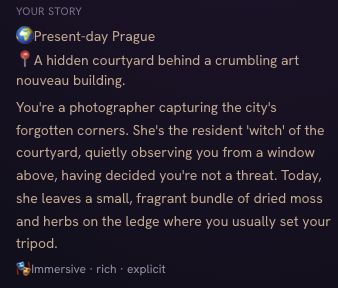
The creator’s story summary, shown with Zora rather than Mara. Review the place, your role in the scene, and the opening situation together.
3. Give her the past you wrote
At the question about her past, choose I’ll write it and paste Mara’s backstory paragraph. This is the dedicated writing step for supplying her history as written. Check that her name, profession, and relationship match your earlier answers.
You can also choose You create it, then review possible pasts or choose Keep it a mystery. Write it yourself when you already know the history you want. The mystery route suits a story where you want to discover the character’s past during play.
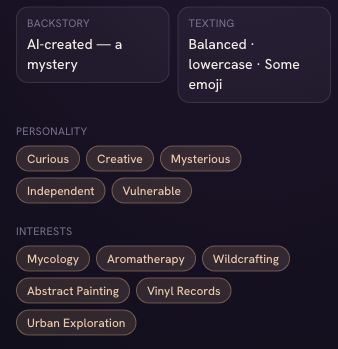
Zora’s setup uses the mystery option. Mara’s worked example uses a backstory you write yourself.
4. Review the whole setup before creating her
Choose the narration style, then read the final character and story summary. Check the relationship as carefully as the biography: Mara should still be someone who has hired your photographer character, with no date or confession already assumed.
Use Change something if a detail needs correcting. When the setup is right, continue with the create button and review the resulting character preview before confirming. Once you enter the scene, try Mara’s first choice from the example: offer practical help while leaving the certificate decision to her.
The screenshots document the creator’s setup and review screens. They do not establish how reliably a finished character will follow every detail over a long conversation; use the follow-up prompts to assess your own story.
Using the template in another app
Use the character editor or backstory control your app documents. Labels and behavior vary, so a template is portable writing material, not a universal import format.
Nomi’s documentation describes Backstory as a place for identity, relationship context, shared history, and setting. It also says the field does not fully determine personality or behavior, and recommends keeping it consistent with the conversation. A detailed setup still needs review as the story develops. Nomi’s backstory guidance
Keep a personal copy of the setup you want to preserve. Distinguish established history from a wish for a future scene: “They met at a cinema” and “she hopes they will visit a cinema together” describe different relationships.
If you are comparing apps, use our Character AI alternatives guide alongside each app’s current creator documentation. Check the actual editing controls before assuming the same fields exist everywhere.
Revise the part that failed
Try an ordinary exchange before the consequential choice. If every line announces the character’s deepest fear, simplify the instruction about when that history should matter.
| What happens in your conversation | What to check first |
|---|---|
| She gives generic replies from the beginning. | Replace one vague trait with an observable preference or behavior. |
| She tells her entire life story in the greeting. | Give the opening one immediate task or question. |
| She writes your feelings or makes your decision. | State that your character’s dialogue, actions, and feelings are yours to write. |
| She contradicts a choice from the previous scene. | Correct the event and review any editable history or memory controls. |
| She refuses every change because the profile says “always.” | Describe a preference and the circumstances under which it could change. |
A backstory is not a guarantee of reliable memory. One good exchange also cannot establish that an app will preserve the same facts over a long story. Our guide to AI companion memory explores that separate question. For these examples, keep the check modest: did this conversation follow the history and choices you actually supplied?
FAQ
How long should an AI character backstory be?
Start with one short paragraph you can explain without rereading it. Include the facts needed for the opening and follow your app’s field limits. Expand when a missing detail creates a specific problem. There is no universal word count that makes a character consistent.
Does a good backstory need trauma?
No. A valued job, a family tradition, an unfinished collaboration, or an invitation can give a character something meaningful to pursue. Choose a past that supports the kind of scene you want to play.
Can I keep part of the character’s past secret?
You can write a secret into your planning notes and decide how to reveal it during play. If you place it in the app’s character setup, do not assume the character will withhold it until your preferred moment. Check whether the app offers relevant controls and assess the actual replies.
Should I rewrite the whole backstory after a bad reply?
First identify what went wrong. A mistaken scene detail may need a correction, while an unclear relationship may need a setup edit. Save the previous version and change one relevant part at a time so you can judge the difference.
Choose the past you want to explore and the moment you want to enter. Create your character in Veyra, give her that history, and leave the next choice open for yourself.
Your own story comes next.
Create a character, choose your mode, and start with 150 free messages.
Start free